

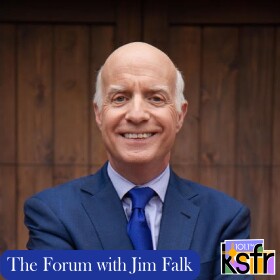
The Forum with Jim Falk
The Forum
Live: Mondays from 6:00 pm to 7:00 pm
Rebroadcast: Wednesdays from 4:00 pm to 5:00 pm
Where important issues of the day are discussed in a hard hitting but civilized manner.
email - forum@ksfr.org
From: Dr. Jeremy M Levin, Executive Chairman and Founder of Ovid Therapeutics.
Author, Biotech in the Balance: Saving a Strategic Industry in an Age of Distrust
"...I had heard about your work, and our conversation more than lived up to my expectations. Too often interviews become exercises in extracting sound bites. Ours felt like radio at its best—a conversation that allowed ideas to develop rather than simply be exchanged..."
-
 This week's Forum features Heather Lamboy, Director of the Santa Fe Land Use Department and Daniel Strongwater, a developer and member of the Board of Friends of Architecture, discussing Santa Fe Forward and the city's current project to update and improve our General Plan and Land Use Code.
 -
This week on the Forum, KSFR News Reporter Patrick Davis and Rev. Talitha Arnold continue the discussion on homelessness in Santa Fe, this time with Nick Svetnicka and Carrie Wilbur from the St. Elizabeth Shelter, and Kent Grubbs of Interfaith Community Services.
-
In the days following the Hamas-led attack of October 7, 2023, President Joe Biden made clear his steadfast support for Israel. But as Israel’s military campaign continued and the humanitarian catastrophe in Gaza deepened, concern and opposition grew within his own administration over Israel’s conduct of the war and America’s continuing support.My guest, journalist Akbar Shahid Ahmed, interviewed more than 150 people for his important new book, Crossing the Red Line: Biden, His Advisors, and Israel’s War in Gaza. During our conversation, Akbar described how Biden relied on a small coterie of advisers, including Secretary of State Antony Blinken, National Security Adviser Jake Sullivan, and Brett McGurk, the National Security Council’s Middle East coordinator, leaving much of the State Department largely on the sidelines.
-
What does it mean for a city to respond to homelessness—and what does that response look like from the perspective of someone who has experienced being unhoused?This week on THE FORUM, we turn to Santa Fe’s unhoused community and the complex challenges facing the city as it works to respond. Our guests bring two very different, but complementary, perspectives to the conversation.Carina Julig, city reporter for The Santa Fe New Mexican, helps us understand the issue from the perspective of city policy, management, and the decisions being made about how Santa Fe responds to homelessness. John Bacon, peer support manager at The Life Link and a former member of the unhoused community, brings the perspective of lived experience and his work supporting others who are navigating homelessness.
-
Just a few weeks before the publication of Ben Macintyre’s latest book, Redwood, I had the pleasure of talking with him about what he considers one of the most intriguing and least-known espionage stories of the Cold War. That’s quite a statement, given Ben’s long list of bestsellers, including The Spy and the Traitor, A Spy Among Friends, and Operation Mincemeat.In this show, Ben shares with me the remarkable story of how KGB officer Vladimir Kuzichkin came to the decision to become a double agent at a critical moment in history. At the height of the Cold War, there was considerable concern that Iran, like neighboring Afghanistan, might fall within the Soviet orbit. The intelligence provided by Kuzichkin gave Britain and the United States an extraordinary window into Soviet intentions and operations in the region.
-
Music is often described as a universal language, but American music may be something even more interesting. It is the product of different cultures, different traditions, different voices - of people borrowing from one another, occasionally argumentatively, and sometimes creating something entirely new.Our guests are American banjo virtuoso Béla Fleck and Colin Jacobsen, artistic director of Santa Fe Pro Musica. Their conversation begins with a discussion of Fleck’s interesting arrangement of George Gershwin's Rhapsody in Blue, which will open Santa Fe Pro Musica's 2026-2027 season and launch its new series, Democratic Vistas. From there, the conversation broadens as Jacobsen explores how music can reflect democratic ideals including different voices in dialogue, disagreement and collaboration and, ultimately, the creation of something more inclusive than one voice.
-
Sebastian Mallaby, senior fellow for global economics at the Council on Foreign Relations, joins Jim Falk for a conversation about his recent New York Times bestseller, The Infinity Machine, and the extraordinary race to develop artificial intelligence.Mallaby takes us inside the world of one of the most important AI pioneers, Demis Hassabis, whose ambition to build machines capable of human-level intelligence helped transform what once seemed like science fiction into one of the defining technological revolutions of our time.Their conversation explores the promise and risks of increasingly powerful AI, the intense competition among companies and nations, and whether the world can develop safeguards, including some form of AI nonproliferation, before the technology moves beyond our ability to control it.
-
This November, New Mexico voters will elect a new lieutenant governor this November. But what exactly should voters expect from the person who holds the state’s second-highest office?On this edition of The Forum, Jim Falk and co-host Peter Smith talk separately with the two candidates for lieutenant governor: Democrat Stephanie Garcia Richard, New Mexico’s Commissioner of Public Lands; and, Republican David Gallegos, a longtime state legislator from southeastern New Mexico.
-
Americans lose billions of dollars each year to fraud, but today’s scams are about far more than stolen credit cards or suspicious emails. On this edition of The Forum, we look at The Business of Deception: how scams work, why even careful and well-informed people can fall victim, and what we can do to protect ourselves and those around us. Criminals are increasingly sophisticated, using stolen identities, convincing impersonations, artificial intelligence, and even cloned voices to gain our trust and separate us from our money. Increasingly, they are also targeting children and older adults, who can be especially vulnerable to deception.
-
With the 2026 midterm elections less than three months away, control of Congress is at stake, but so are larger questions about presidential power, the role of Congress, and Americans’ declining trust in their political institutions.Tonight’s discussion centers on the Common Sense Coalition’s recently published report, Betrayed: America Didn’t Vote for This, which was written and edited by a group of Republican and Democratic experts who describe their work as a “damage assessment” of the first 16 months of Trump 2.0.During the conversation, John Lawrence and Ira Shapiro examine how the Trump administration has taken actions they argue go far beyond what was promised during the 2024 campaign.